
Non Destructive Testing for Contrete
Explore Hassle-Free Non-Destructive
Testing Solutions
Elevate your asset management with our premier Non-Destructive Testing (NDT) Services, setting the standard in India. Backed by a proven track record and unmatched expertise, we deliver comprehensive analyses of your assets with precision and reliability.
Our suite of NDT services encompasses a spectrum of techniques meticulously crafted and executed by our seasoned professionals. From detecting defects to evaluating concrete properties such as strength and durability, we offer tailored solutions to meet your specific needs.
Experience the power of Total Quality Assurance with our array of services, supporting your production processes, ensuring quality control, and facilitating regulatory compliance.
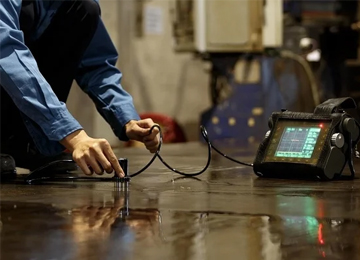
Our Non Destructive Testing Services include:
- Rebound Hammer testing
- Ultrasonic pulse velocity testing
- Ultrasonic echo testing
- Half-Cell potential testing
- Digital concrete microscope testing
- Profometer testing
- Sonic Echo testing
- Stress wave testing
- Carbonation Testing
- Concrete Core Testing
- Ingredient Analysis of Concrete Core
- Corrosion Analysis of Rebars in Concrete
- Probe penetration testing
- Linear polarisation testing
- Ground Penetrating Radar testing
- Combined Method UPV & RH Test
- Core Extraction for Compressive Strength Test
Rebound Hammer Test (Schmidt Hammer Test)
- Purpose: Surface hardness & approximate compressive strength
- Method: A spring-controlled hammer impacts the concrete; rebound distance gives hardness.
- Standard: IS 13311 (Part 2) / ASTM C805
- Applications: Estimating uniformity, comparing relative strengths in different areas.
Ultrasonic Pulse Velocity (UPV) Test
- Purpose: Internal flaws, cracks, voids & quality grading
- Method: High-frequency sound waves are passed through concrete; velocity is measured.
- Standard: IS 13311 (Part 1) / ASTM C597
- Applications: Detect honeycombing, poor bonding, segregation, and strength variations.
Core Cutting & Testing (Semi-NDT)
- Purpose: Direct compressive strength test
- Method: Core samples drilled from concrete are tested in a lab.
- Standard: IS 516 / ASTM C42
- Applications: When actual strength confirmation is essential; semi-destructive.
Cover Meter / Reinforcement Locator
- Purpose: Locate rebars, measure concrete cover depth
- Method: Electromagnetic device scans concrete and detects metal.
- Standard: BS 1881-204 / ASTM G57
- Applications: Check rebar spacing, diameter, cover adequacy before repair or drilling.
Half-Cell Potential Test
- Purpose: Corrosion activity in steel reinforcement
- Method: Measures electrical potential between reinforcement and reference electrode.
- Standard: ASTM C876
- Applications: Identifying corrosion-prone areas in RCC structures.
Carbonation Depth Test
- Purpose: Determine depth of carbonation that can trigger corrosion
- Method: Phenolphthalein solution sprayed on freshly broken surface; color change observed.
- Standard: RILEM CPC-18
- Applications: Used in old or exposed concrete to detect pH loss due to atmospheric CO₂.
Infrared Thermography (Thermal Imaging)
- Purpose: Detect moisture intrusion, voids, delaminations
- Method: Infrared camera detects surface temperature variations.
- Standard: ASTM C1153
- Applications: Locating seepage zones, hidden leaks, or uneven thermal conductivity.
Ground Penetrating Radar (GPR)
- Purpose: Imaging sub-surface elements – rebars, voids, pipes
- Method: Electromagnetic pulses penetrate concrete; reflections are interpreted.
- Standard: ASTM D6087 / ACI 228.2R
- Applications: Advanced scan for mapping embedded utilities or delaminations.
Impact Echo Test
- Purpose: Locate delaminations, voids, honeycombing
- Method: Low-frequency mechanical impact is used; surface vibrations are measured.
- Standard: ASTM C1383
- Applications: Quality checks in precast panels, slabs, bridges, etc.
Radiographic Testing (X-ray or Gamma Ray)
- Purpose: High-resolution view of internal structure
- Method: Radiation passes through concrete; captured on a film or detector.
- Standard: ASTM E94 / ASTM E1030
- Applications: Critical for nuclear or sensitive structural elements; expensive and rarely used on-site.
Windsor Probe Test
- Purpose: In-situ compressive strength estimation
- Method: Hardened alloy probe is driven into concrete using gunpowder charge; penetration depth is measured.
- Standard: ASTM C803
- Applications: Forensic testing or heritage structures where coring is not allowed.
Surface Resistivity Test
- Purpose: Durability and chloride ion penetration resistance
- Method: Electrical resistivity of the concrete surface is measured using four probes.
- Standard: AASHTO TP 95 / ASTM C876
- Applications: Identifies potential durability in aggressive environments.
Acoustic Emission Technique
- Purpose: Monitor progressive internal cracking in real time
- Method: Acoustic sensors detect stress-induced emissions from micro-cracking.
- Standard: ASTM E1316
- Applications: Used in bridges, dams, and research applications for continuous monitoring.
Dye Penetration Test (Capillary Absorption Check)
- Purpose: Check surface permeability
- Method: Dye is applied to surface; absorption pattern reveals microcracks and porosity.
- Standard: Non-standard visual test
- Applications: Leak tracing and inspection of porous areas.
Pull-Out Test
- Purpose: Estimate in-place concrete strength
- Method: Steel insert embedded in concrete is pulled out to measure force.
- Standard: ASTM C900
- Applications: Often used in combination with rebound hammer or core test.
Ultrasonic Echo / Impulse Echo Testing
- Purpose: Detects internal flaws such as delamination, honeycombing, and voids in slabs or beams.
- How it works: Echo from ultrasonic pulses reflects off defects. A single-side access test.
- Use: Especially useful in inaccessible areas like tunnels or bridge decks.
Profometer Testing (Rebar Locator & Covermeter)
- Purpose: Detects location, spacing, and depth of reinforcement (rebars) and concrete cover.
- Principle: Uses electromagnetic field detection.
- Importance: Ensures adequate concrete cover and rebar placement for safety and durability.
Sonic Echo Testing
- Purpose: Verifies the integrity and depth of concrete piles, slabs, or foundation elements.
- Procedure: A mechanical impact generates sound waves; reflections are analyzed.
- Outcome: Detects voids, cracks, or changes in cross-section of deep foundations.
Stress Wave Testing (Impact Echo / Pulse Velocity)
- Purpose: Assesses thickness, voids, or delaminations in concrete using low-strain impact waves.
- Application: Ideal for evaluating pre-cast elements, decks, or tunnel linings.
Combined Method: UPV + RH (Rebound Hammer)
- Purpose: A dual-technique for estimating compressive strength and surface hardness.
- Method:
- UPV: Checks internal quality.
- RH: Measures surface hardness (Rebound number).
- Result: A more reliable strength estimate when combined with correlation charts.
Digital Concrete Microscope Testing
- Purpose: Visually examines concrete surface cracks, porosity, microstructural damage at high resolution.
- Use: Crack width measurement, micro-pore analysis, quality validation of repair work.
Core Extraction for Compressive Strength Test (Semi-destructive)
- Purpose: Measures actual in-situ compressive strength of hardened concrete.
- Procedure: Cylindrical concrete cores (usually 100 mm or 150 mm diameter) are extracted and tested under a compression machine.
- Standard: IS 516 / ASTM C42
- Insight: Considered the most accurate method, especially for old buildings.
Ingredient Analysis of Concrete Core (Semi-destructive)
- Purpose: Determines composition and quality of materials used — cement type, sand, aggregates, water–cement ratio, etc.
- Methods:
- Chemical analysis for cement content.
- Sieve analysis for aggregate gradation.
- Chloride & sulfate content check.
- Importance: Useful in failure analysis or forensic audits.
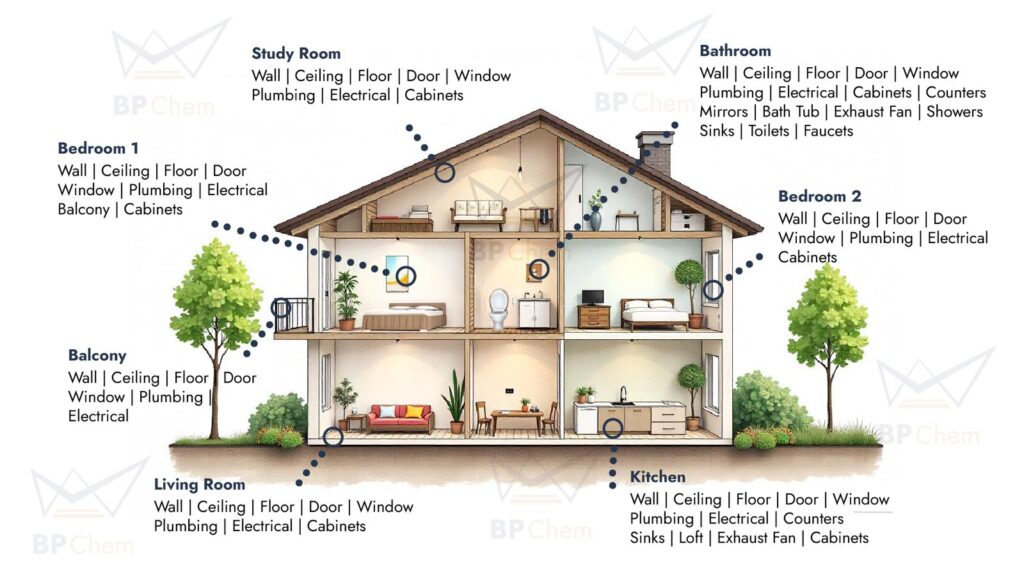
Real Estate Developer Problems
– Third Party Construction Finishing / Pre-delivery Project Inspections
Home Buyers / Owners Problems
– Health & Safety Check of properties. Full Diagnostic (All Areas/ Elements) with Solutions
Damp/ Seepage Problems – All Properties
– Tracking concealed problems to the source using latest technology
– Long Term – Least Destructive – Low Cost Solutions
Electrical & Safety Hazards – All Properties
– Electrical & Safety Inspections with solutions